
Tooth development begins long before a baby’s first tooth appears. Teeth start forming inside the jaw around the sixth week of pregnancy, pass through six overlapping stages of growth and hardening, then emerge through the gums on a timeline that runs from about 6 months of age into the late teens.
Formation and eruption are separate events. A tooth can be fully shaped beneath the gums for months or years before it becomes visible. This blog covers the six stages of tooth development, a child’s tooth development timeline by age, and the signs that warrant a visit to a pediatric dentist. Timing varies from child to child, so the ranges below are general references, not diagnostic cutoffs.
Table of Contents
The 6 Stages of Tooth Development
Dentists use the term odontogenesis for the way a tooth forms, from the first cellular signals in the jaw to the hardening of enamel. The six stages of tooth development describe this formation process: the stages overlap rather than following a strict sequence.
Initiation, Bud, and Cap Stages
Initiation is the starting signal. According to Johns Hopkins Medicine, tooth development begins at about six weeks of gestation, when a band of tissue in the future jaws begins organizing into teeth. In the bud stage, a small swelling forms along this band for each future tooth. In the cap stage, each bud folds into a cap shape, and the tissues that will produce enamel, dentin, and pulp begin to organize. For baby teeth, all of this happens before birth.
Bell, Apposition, and Maturation Stages
In the bell stage, the developing tooth takes on its crown shape, and specialized cells prepare to build its hard tissues. During apposition, those cells lay down dentin and enamel in layers, with dentin forming first. Maturation, or mineralization, is when minerals harden those layers. The American Academy of Pediatric Dentistry lists calcification of baby teeth as beginning in the fourth month of pregnancy, and calcification of the first permanent molars as beginning at birth. Roots keep developing after the crown is complete, even after eruption.
Development and eruption are related but separate. The textbook StatPearls defines eruption as a tooth’s movement into its working position in the mouth; emergence, when the crown breaks through the gums, is only the final visible step.
| Stage | What Happens | What It Means for Parents |
|---|---|---|
| Initiation | Cells in the developing jaw receive signals to begin forming teeth. | Development starts early in pregnancy. |
| Bud | A small swelling forms for each future tooth. | Each baby tooth begins as its own bud inside the jaw. |
| Cap | The bud folds into a cap shape as the tissues for enamel, dentin, and pulp organize. | For baby teeth, this stage happens entirely before birth. |
| Bell | The crown takes its final shape, and cells specialize to build hard tissue. | The size and shape of each tooth are largely set at this stage. |
| Apposition | Dentin and enamel are laid down in layers. | Enamel forms before the tooth is visible. |
| Maturation / mineralization | Minerals harden the enamel and dentin, and roots continue to form. | A tooth may be fully formed under the gums for months or years before it erupts. |
Tooth Development Stages by Age
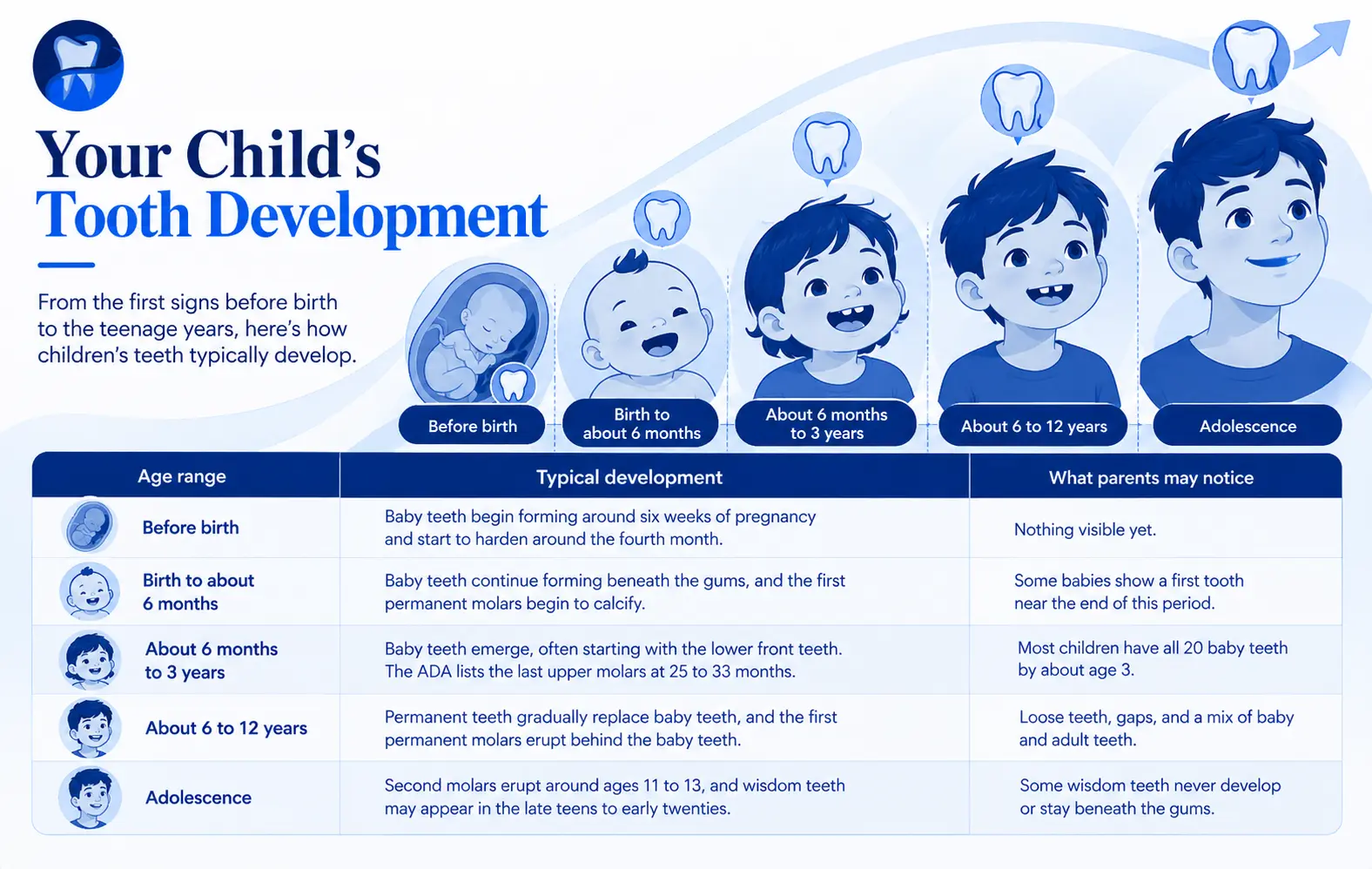
Tooth development stages by age follow a general pattern, but healthy children vary. According to StatPearls, a difference of up to six months before or after a typical eruption date is usually considered normal, and the order of arrival also differs.
Baby Teeth, Permanent Teeth, and Mixed Dentition
Children typically have 20 baby teeth and up to 32 permanent teeth. For a period the AAPD places at approximately ages 6 to 11, children have both baby and permanent teeth at once, a stage dentists call mixed dentition.
The transition usually begins around age 6, about when kids lose their first tooth, as the lower front baby teeth loosen and the first permanent molars erupt behind the last baby molars. Because these molars do not replace a baby tooth, parents sometimes mistake them for baby teeth. Front teeth are replaced first, while baby canines and molars give way to permanent canines and premolars later, often between ages 9 and 12.
What Is Normal and When to Call a Pediatric Dentist
Some variation in tooth development is usually normal. A child’s first tooth may appear somewhat earlier or later than 6 months, teeth may come in a different order than charts show, mild gum tenderness can occur during teething, and loose baby teeth often begin around age 6. Consider calling a pediatric dentist if a tooth seems significantly delayed compared with the child’s usual pattern, there is notable asymmetry between matching teeth, or the child has persistent pain, swelling, fever, trouble eating or sleeping, or loses a baby tooth early without an injury or clear reason.
How Parents Can Support Healthy Tooth Development
These habits below help support healthy teeth, although they cannot prevent every variation in how teeth develop.
- Establish a dental home when the first tooth appears or by the first birthday, as the American Academy of Pediatric Dentistry recommends.
- Brush twice daily with fluoride toothpaste in the amount a dental professional advises: typically a smear before age 3 and a pea-sized amount from ages 3 to 6. See our guide recommending when to start brushing baby teeth.
- Support a balanced diet and limit frequent sugary snacks and drinks.
- Attend regular checkups so a dentist can track how teeth develop over time.
Families in Northern Virginia can schedule an evaluation with Kakar Dental Group, which provides pediatric dentistry at its Tysons, Falls Church, Manassas, and Fredericksburg locations.
Frequently Asked Questions
What are the six stages of tooth development?
Do all children get teeth at the same age?
How many baby teeth and permanent teeth do children have?