
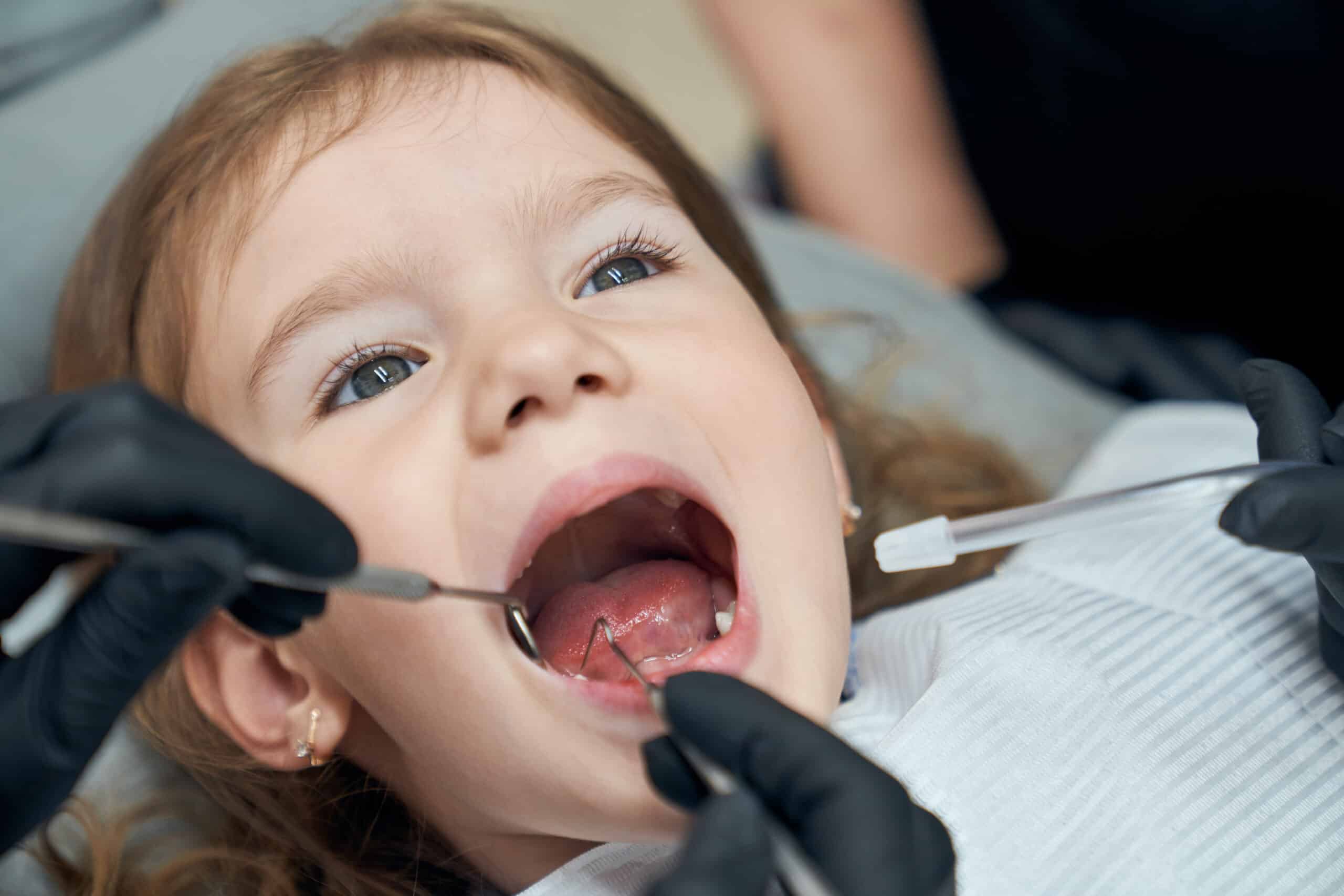
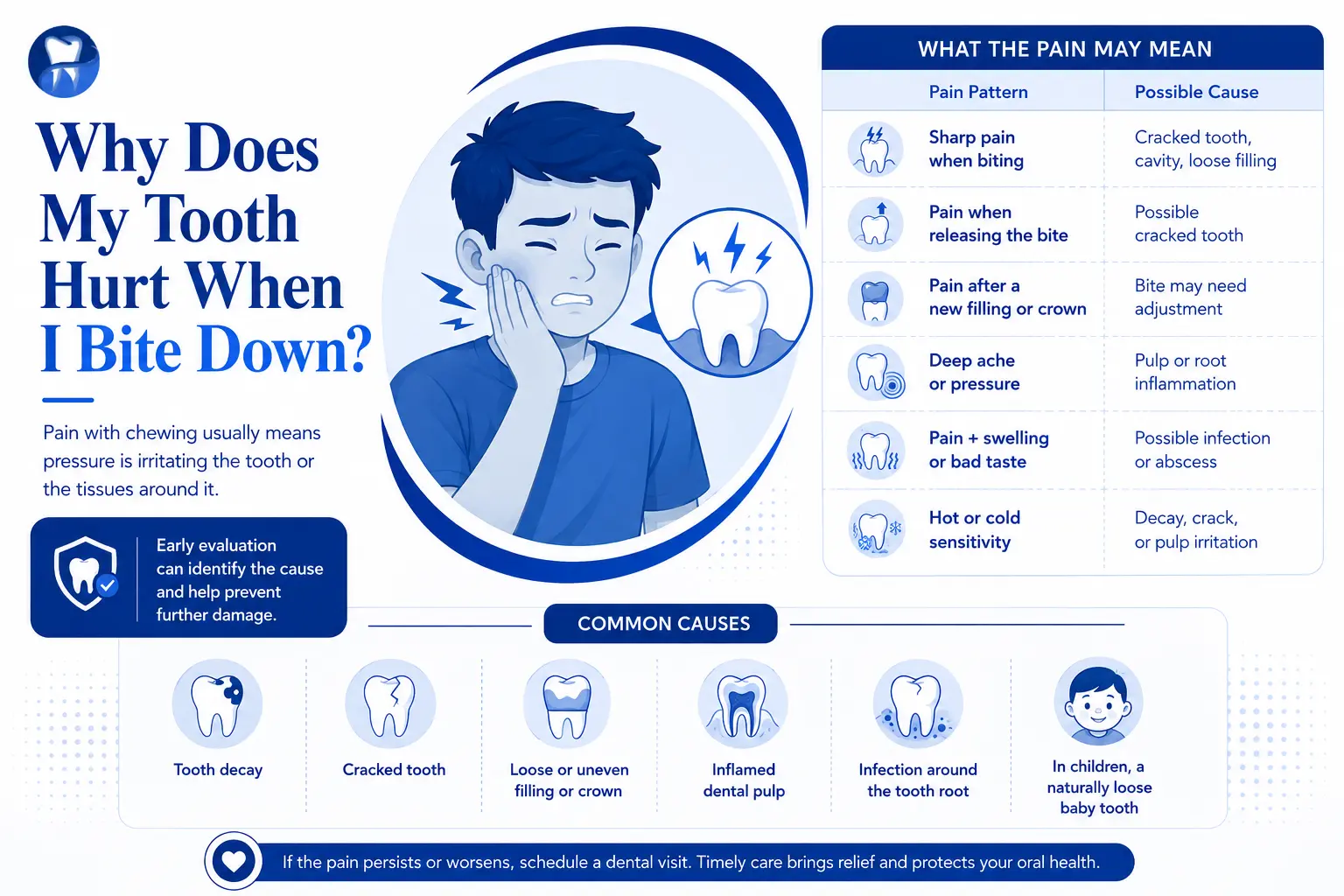
If your tooth hurts when you bite down, the pain is usually a sign that pressure from chewing is irritating the tooth or the tissues around it. Common causes include tooth decay, a cracked tooth, an inflamed or infected dental pulp, a loose or uneven filling or crown, and inflammation around the tooth root.
The way the pain feels can offer useful clues. A sharp pain that appears only when biting may be associated with a crack or restoration problem, while persistent pressure, swelling, temperature sensitivity, or throbbing may suggest deeper inflammation or infection.
However, symptoms alone cannot tell you exactly what is wrong. Several dental problems can produce similar tooth pain when biting down, so persistent or worsening pain should be evaluated by a dentist.
| What the Pain Feels Like | Possible Explanation |
|---|---|
| Sharp pain during biting | Cracked tooth, decay, loose restoration |
| Pain when releasing the bite | Can occur with a cracked tooth |
| Pain after a new filling or crown | Bite may need adjustment or pulp may be irritated |
| Deep ache or pressure | Inflammation around the pulp or tooth root |
| Pain with swelling or bad taste | Possible dental infection or abscess |
| Pain with hot or cold sensitivity | Decay, pulp irritation, crack, or exposed tooth structure |
| Pain around a loose baby tooth | Normal eruption/exfoliation may contribute in children, but significant pain should still be checked |
Table of Contents
My tooth hurts when i bite down – What’s Causing It?
The American Association of Endodontists lists decay, loose fillings, cracked teeth, and pulp damage among the possible causes of sharp pain when biting.
A Loose Baby Tooth
For children, discomfort when biting can sometimes come from a baby tooth that is becoming loose as the permanent tooth develops underneath it.
Mild tenderness around a naturally loosening tooth can occur. However, significant pain, swelling, pus, fever, trauma, or a tooth that is painful long before it is expected to fall out should not automatically be attributed to normal tooth loss.
A pediatric dentist can determine whether the discomfort is part of normal development or whether decay, infection, injury, or another dental problem is also present.
Tooth Decay or a Cavity
A cavity can cause pain when chewing if decay has progressed far enough to affect deeper tooth structure. Early tooth decay may cause few or no symptoms. Parents who are unsure what a cavity looks like may notice white, brown, or dark areas, visible pits or holes, or changes in the tooth surface as decay progresses. As it progresses, a tooth may become sensitive to sweet, hot, or cold foods and can develop pain or tenderness. In some cases, tooth sensitivity to sweets can be an early sign of enamel damage or decay, although sensitivity can also have other causes. In more advanced cases, bacteria may reach the pulp inside the tooth and cause inflammation or infection.
The NHS notes that tooth decay can eventually cause toothache, sensitivity, visible holes or discoloration, and in some cases a dental abscess.
If you’re unsure whether a cavity is responsible, a dental examination is more reliable than trying to diagnose the tooth based on pain alone.
If the pain began after recent dental work, symptoms such as jaw pain after filling may also be related to bite changes, muscle strain from keeping the mouth open, or irritation around the treated tooth.
Dental Abscess or Infection
Pain when biting can occur when infection or inflammation affects the pulp inside a tooth or the tissues around its root.
An abscess may also cause:
- persistent or throbbing toothache;
- gum or facial swelling;
- sensitivity to hot or cold;
- a bad taste in the mouth;
- difficulty chewing;
- fever or swollen lymph nodes in some cases.
A dental abscess requires professional treatment and does not resolve simply because the pain temporarily improves. Treatment depends on the cause and condition of the tooth and may involve drainage, root canal treatment, extraction, or other dental care
Cracked Tooth
A cracked tooth is one of the classic causes of sharp or intermittent pain when biting or chewing.
The pain may appear only when pressure is placed on a particular part of the tooth and may sometimes occur when the bite is released. Some cracked teeth also become sensitive to hot or cold temperatures.
The reason can be difficult to identify at home because cracks are not always visible. According to the American Association of Endodontists, cracked teeth can cause erratic chewing pain, temperature sensitivity, or pain when bite pressure is released.
Treatment depends on how deep the crack extends and which part of the tooth is involved. Some cracks can be restored, while deeper cracks involving the pulp or root require different treatment.
Advantages of Having a Family Pediatric Dentist
If your child approaches you and says, “My tooth hurts when i bite down,” the best course of action is to schedule a pediatric dental appointment immediately. Having a regular dentist your child is familiar with will make this easier and less stressful for them and ensure you get seen ASAP.
Frequently Asked Questions About Tooth Pain When Biting
Why does my tooth hurt when I bite down?
Why does my molar hurt when I bite down?
Why does only one tooth hurt when I bite?

Comments are closed.