

When a child’s tooth is severely damaged by decay or injury, restoring it promptly is essential, not just for comfort, but for your little one’s overall oral development. Primary teeth, often called baby teeth, do far more than help children chew. They hold critical space for adult teeth, support proper speech development, and shape the foundation for a lifetime of good oral hygiene. Because of this, pediatric dentists generally prefer to restore rather than remove a damaged tooth whenever possible.
In pediatric dentistry, stainless steel crowns, commonly known as silver caps, have served as the gold standard for decades, particularly for back teeth that endure significant chewing forces. They are durable, cost-effective, and have a proven track record. For high-risk children or heavily decayed primary teeth, they remain a clinically sound option.
That said, many parents today are asking about an alternative to silver caps on toddler teeth. Concerns about visible metal, the natural desire to preserve a child’s smile, and questions about metal allergies have prompted significant advances in pediatric dental crowns. Today, families have more choices than ever — and a qualified pediatric dentist can help you navigate them.
Table of Contents
Understanding Pediatric Crowns: Why Full Coverage Matters
Before exploring crown options, it helps to understand why a crown may be recommended over a standard filling. When decay is extensive, when multiple surfaces of a child’s tooth are involved, or when a “baby root canal” has been performed, a dental filling alone typically cannot protect what remains of the tooth structure. A full-coverage crown, a type of crown that encases the entire visible portion of the tooth, provides far greater protection against further damage.
Evidence-based guidelines in pediatric dentistry are clear: full-coverage restorations are the best choice for primary molars with extensive decay or following pulp therapy. When decay is minor and significant healthy tooth structure remains, dental fillings or other conservative options may be appropriate but crown placement is often the most reliable path forward for a severely decayed tooth.
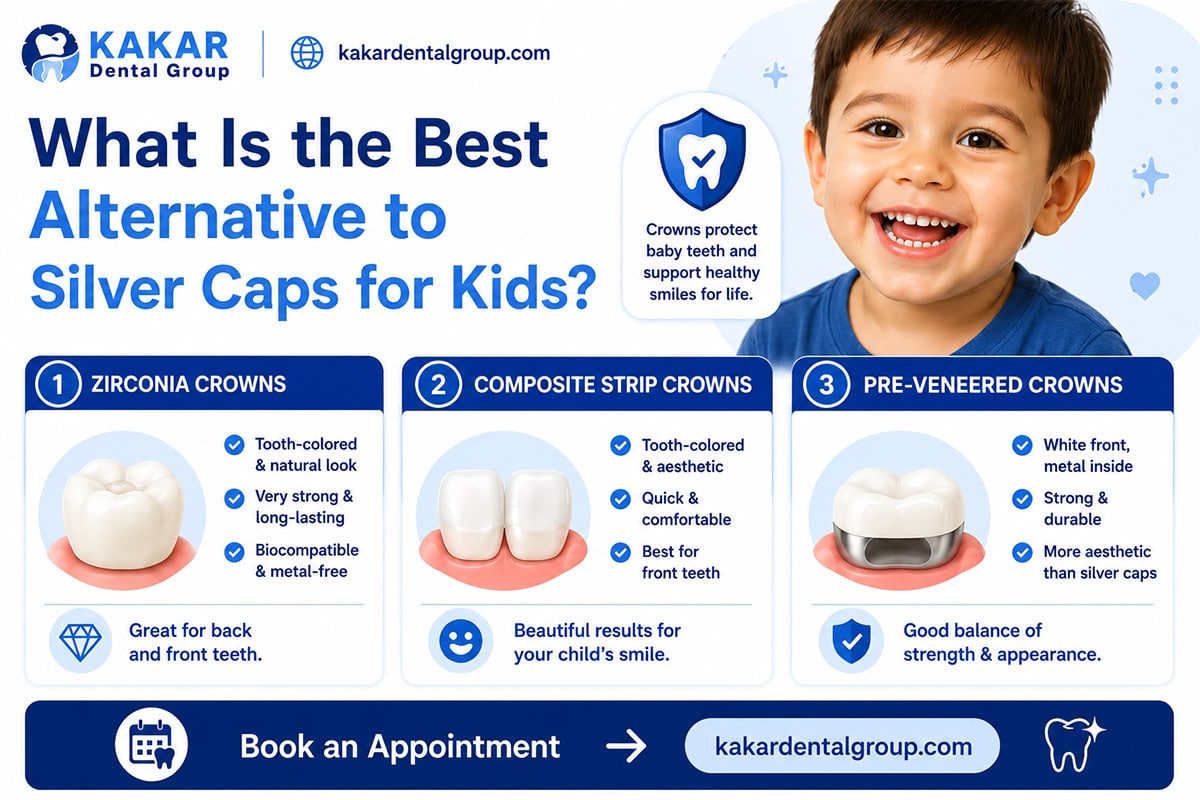
Zirconia Crowns: The Leading Alternative for Children’s Teeth
Among the alternatives to traditional stainless steel, zirconia crowns have emerged as the most widely studied and clinically supported option. Made from zirconium dioxide — a strong ceramic material — these prefabricated tooth-colored crowns offer impressive fracture resistance, high biocompatibility, and a natural color that closely mimics the appearance of healthy primary teeth.
Zirconia crowns are particularly well-suited for children with early childhood cavities, developmental enamel defects, or traumatic dental fractures where both strength and aesthetics matter. It is worth noting, however, that ceramic crowns require more tooth reduction than stainless steel and come at a higher cost. Your child’s specific needs, age, and cavity risk will help determine whether zirconia is the best option.
Composite Strip Crowns: A Tooth-Colored Choice for Front Teeth
For primary incisors — the front teeth most visible in a child’s smile — composite strip crowns are a popular choice. This type of dental restoration uses a clear mold filled with tooth-colored composite resin to rebuild the visible portion of a decayed tooth. The result is a highly aesthetic crown option that restores a natural appearance quickly, which can be meaningful for younger children whose confidence may be affected by visible decay. Composite crowns are less resistant to the heavy wear and tear of chewing forces than zirconia or stainless steel, which is why they are typically preferred for front teeth rather than back molars.
Pre-Veneered Crowns: A Hybrid Approach
For families seeking a middle ground between maximum durability and improved appearance, pre-veneered stainless steel crowns offer a hybrid solution. These crowns combine the structural strength of a stainless steel shell with a tooth-colored resin on the visible front surface. This reduces the metallic appearance while preserving the underlying strength that has made stainless steel a reliable choice for generations.
The tradeoff is aesthetic longevity: the white facing material can chip over time, and the result is often less visually seamless than a full ceramic or zirconia crown. For families concerned about metal allergies, it is also worth noting that the stainless steel base is still present, so parents with sensitivity concerns should discuss alternative materials with their pediatric dentist.
What About Dental Fillings and Space Maintainers?
Not every situation calls for a crown. When decay is limited and significant healthy tooth structure remains, dental fillings may be sufficient.
In some situations, when a baby tooth is severely compromised and close to its natural time of exfoliation, extraction followed by a space maintainer may be the most appropriate path. A space maintainer holds the gap open so the permanent tooth can erupt properly, avoiding crowding and alignment problems down the road. Your pediatric dentist will evaluate your child’s age, the state of the primary tooth, and the proximity of the permanent tooth beneath it before making a recommendation.
Trust Kakar Dental Group with Your Child’s Dental Health
At Kakar Dental Group, our specialists are committed to providing evidence-based, patient-centered dental treatment in a warm, family-friendly environment. We take the time to explain every option and tailor our recommendations to your child’s specific needs — because your child’s dental health is at the heart of everything we do.
We proudly serve families across Northern Virginia from our locations in Tysons, Falls Church, Manassas, and Fredericksburg. Schedule an Appointment Today. Our team is here to help your little one smile with confidence.