
A tooth abscess doesn’t always announce itself with a screaming toothache. In young children, the first sign is often quieter: a small gum bump, a bad taste, or a child who suddenly chews on one side. A tooth abscess in a child is an infection around a tooth or in the gum, and it needs prompt dental care because it can worsen or spread, even if it drains or the pain eases.
Parents often search for tooth abscess stages in a child to gauge how serious things are. Stages help explain the changes you may notice, but they are not a countdown or a home diagnostic tool. If you suspect an abscess, call a pediatric dentist promptly.
Table of Contents
What a Tooth Abscess Can Look and Feel Like in a Child
A child tooth abscess may cause a toothache, pain when chewing, a pimple-like gum bump, drainage, or swelling of the gums or face. Younger children often can’t describe pain, so watch their behavior: avoiding food, favoring one side, or unusual irritability. Because a draining bump may cause little discomfort and symptoms can come and go, appearance alone cannot confirm a diagnosis.
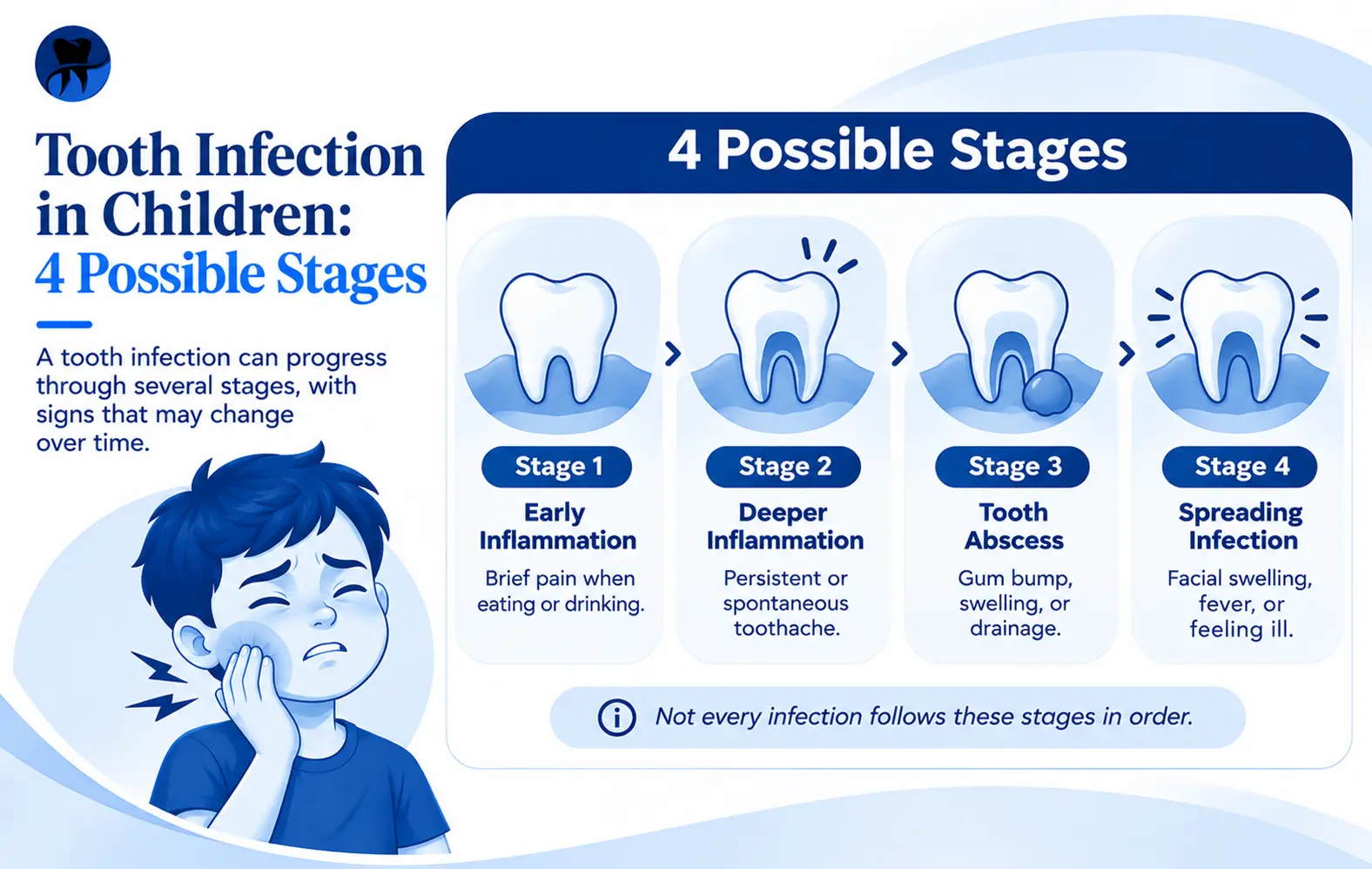
Child Tooth Abscess Stages: A Practical Progression
Picture the infection as it moves: first inside the tooth, then around it, and in serious cases beyond it. Dentists track the pulp, the living tissue inside the tooth, and according to the American Academy of Pediatric Dentistry, the health of the pulp determines which treatment is appropriate. Not every infection follows these steps in order.
| Possible Progression | What a Parent May Notice | What to Do Now |
|---|---|---|
| Inside the tooth: early inflammation | Brief pain with eating or drinking | Call the dentist; early care may protect the pulp |
| Inside the tooth: deeper inflammation | Pain that starts on its own or lingers | Arrange a prompt dental visit |
| Around the tooth: abscess | Gum swelling, a bump, drainage, or pain when biting | Seek same-day dental advice |
| Beyond the tooth: spreading infection | Facial swelling, fever, or a child who seems ill | Get urgent care; go to the ER for breathing or swallowing problems |
When a Child’s Tooth Abscess Needs Urgent or Emergency Care
The AAPD lists facial swelling, infections, and pain among dental emergencies, and advises that signs such as fever or facial swelling warrant emergency treatment. Seek urgent care if your child has:
- Facial, neck, or eye-area swelling
- Fever or marked tiredness
- Difficulty swallowing, breathing, or opening the mouth
- Refusal to drink or signs of dehydration
Go to the emergency room or call 911 for breathing or swallowing difficulty, rapid facial or neck swelling, or severe illness. Untreated infections can spread to the sinuses, bone, or tissues around the eye, so do not wait for a fever.
What Causes a Tooth Abscess in a Child?
The most common cause is untreated tooth decay in kids that reaches the pulp. A crack or injury can also open a path for bacteria, sometimes long after a fall, which is why the follow-up visits after a toddler hit a tooth and bruised the gum matter. A gray tooth in a toddler with a new gum bump deserves the same prompt call. These problems can develop quietly in any family, and a dental exam finds the source.
What to Do If My Child Has an Abscess Tooth
- Contact a pediatric dentist promptly.
- Keep your child comfortable and offer soft foods.
- Use a cool compress on the outside of the face if it helps.
- Encourage fluids.
- Follow your clinician’s age-appropriate advice about pain medication.
Do not lance the swelling or rely on saltwater, supplements, or other home remedies to clear the infection.
Child Tooth Abscess Treatment: What the Dentist May Consider
Treatment depends on the tooth and how far the infection has spread. The AAPD notes that odontogenic infections are usually managed with pulp therapy or extraction, and that those with swelling may need incision and drainage. For a baby tooth, that may mean a pulpectomy, which cleans and fills the inside of the tooth. For infections centered in the gum, see our overview of gum abscess treatment.
Why Your Dentist May Not Prescribe Antibiotics
Many parents expect a prescription and are surprised to receive a treatment plan instead. AAPD guidance explains why: antibiotic therapy usually is not indicated when the infection is contained within the tooth or the immediately surrounding tissue. In those cases, treating the tooth removes the source of the infection, and that is the cure. Antibiotics are added when the infection spreads or causes fever, and even then they support treating the source rather than replace it. No prescription does not mean the infection is being ignored.
A Quiet Infection Still Deserves a Prompt Call
Understanding tooth abscess stages in a child helps you act quickly, but professional care is what resolves the infection, and it is simpler the earlier it begins. If your child has tooth pain, gum swelling, or a suspected abscess, contact Kakar Dental Group promptly for pediatric dental guidance.
Reach our pediatric dentist Fredericksburg VA office or our Tysons, Falls Church, and Manassas locations for prompt, gentle pediatric dentistry for children across Northern Virginia.
Frequently Asked Questions
Can a child's tooth abscess go away on its own?
What does a tooth abscess look like in a child?
Can I treat a child's tooth abscess at home?
What causes a tooth abscess in a child?
Will my child need antibiotics?
Can a baby tooth abscess affect the adult tooth?