

Parents sometimes notice children with shiny, silver-colored teeth and wonder what they are or why a dentist would place them. In most cases, the “silver teeth” seen in children are stainless steel crowns, also called silver caps, placed over baby teeth that need more protection than a regular filling can provide.
A pediatric dentist may recommend a stainless steel crown when a primary tooth has extensive decay, has been weakened by damage, has a developmental defect, or needs full coverage after certain types of pulp treatment. The goal is to restore the tooth so the child can continue chewing comfortably while the baby tooth remains in place.
Silver crowns are different from silver-colored amalgam fillings. A filling repairs a specific portion of a tooth, while a stainless steel crown covers the visible part of the tooth and provides full-coronal protection.
AAPD guidance identifies preformed metal crowns, including stainless steel crowns, as an established restorative option for primary teeth with extensive caries and several other clinical indications
Table of Contents
What Are the Silver Teeth You See on Kids?
The silver teeth you may notice on a child are usually stainless steel crowns placed over primary teeth, particularly baby molars.
These crowns are prefabricated in several sizes. The pediatric dentist selects the appropriate size, adjusts it to the tooth, and cements it into place so the remaining tooth structure is fully covered.
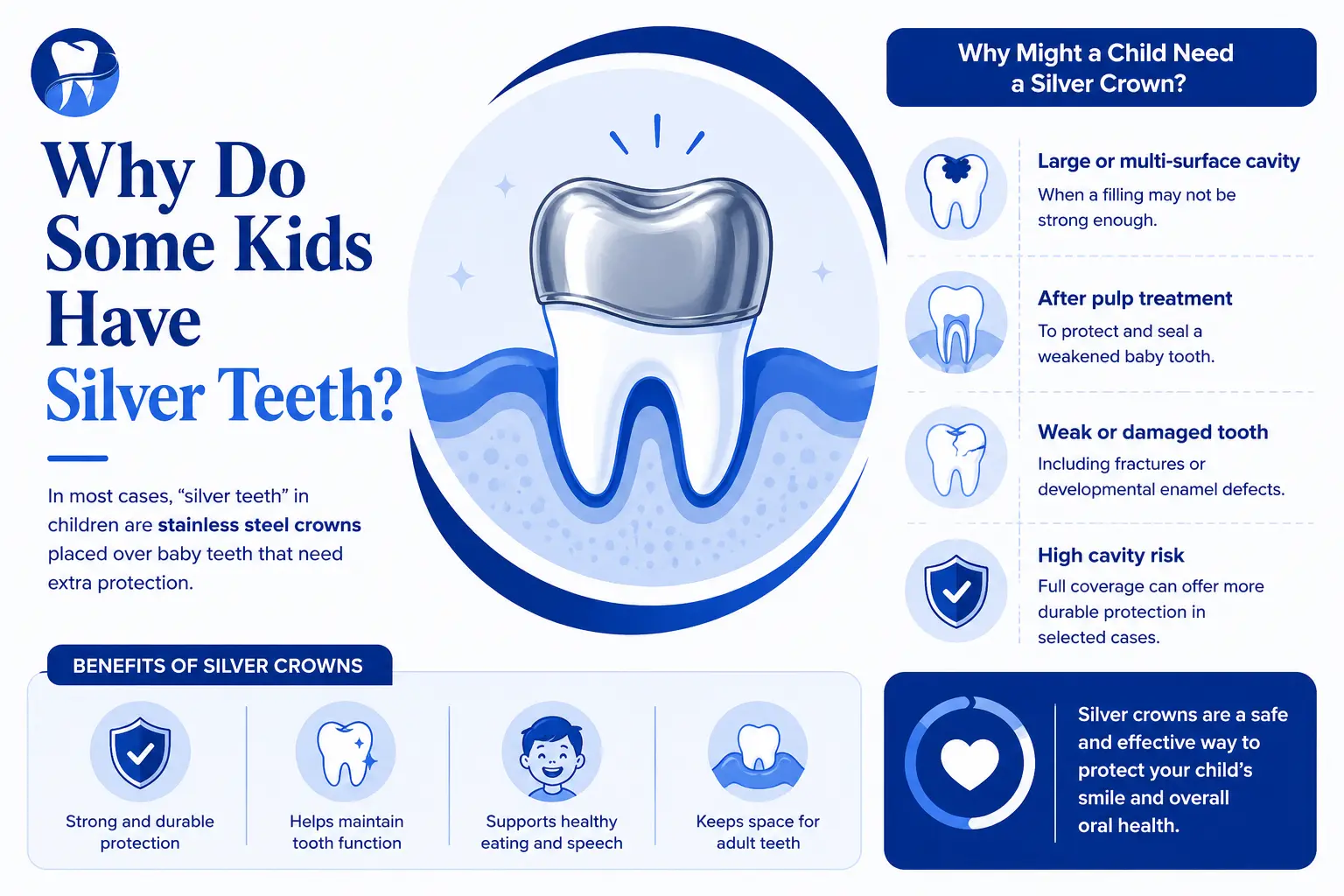
Unlike a filling, which replaces only the portion of a tooth damaged by a cavity, a crown surrounds the visible part of the tooth. This makes full-coverage crowns useful when there is not enough strong tooth structure left for a conventional filling to provide a predictable restoration.
The American Academy of Pediatric Dentistry describes preformed metal crowns as an option for primary teeth affected by extensive decay, developmental defects, fractures, or situations where another restorative material is more likely to fail.
Why Do Kids Get Silver Teeth?
There is no single reason why some kids have silver teeth. The decision depends on how much healthy tooth structure remains, the condition of the pulp inside the tooth, the child’s cavity risk, and how long the primary tooth is expected to remain in the mouth.
1. The cavity is too large for a regular filling
Small and moderate cavities can often be restored with a dental filling. When decay involves several surfaces of a baby molar or leaves the tooth significantly weakened, a full-coverage crown may provide a more dependable restoration.
AAPD guidance specifically supports stainless steel crowns for primary molars with extensive or multisurface decay.
2. The tooth needs protection after pulp treatment
Deep decay can sometimes reach or closely approach the pulp inside a primary tooth. Depending on the diagnosis, a pediatric dentist may recommend pulp therapy to preserve the tooth.
After certain pulp treatments, a stainless steel crown is commonly used to provide a durable seal and protect the remaining tooth structure.
3. The tooth is weak or damaged
Crowns may also be considered when a primary tooth has been fractured or when the enamel did not develop normally. Developmental defects such as hypoplasia or hypocalcification can leave a tooth more vulnerable to wear or decay.
AAPD restorative guidance includes developmental defects and fractured teeth among the situations in which preformed metal crowns may be appropriate.
4. The child has a high risk of developing additional cavities
Children with extensive decay or a high caries risk sometimes benefit from restorations that cover more of the tooth surface. The treatment choice should still be individualized based on the child’s age, oral health, cooperation, the condition of the tooth, and the dentist’s clinical assessment.
Silver Crown vs. Silver Filling: What Is the Difference?
Parents often use “silver tooth,” “silver crown,” and “silver filling” interchangeably, but these treatments are not the same.
| Stage / Finding | Possible Treatment | Goal |
|---|---|---|
| Very early enamel changes without a cavity | Fluoride and improved home care | Strengthen enamel and slow or reverse early demineralization |
| Small to moderate cavity | Dental filling | Remove decay and restore the tooth |
| Large cavity or weakened baby tooth | Stainless steel crown or another appropriate restoration | Protect and strengthen the remaining tooth |
| Decay close to or involving the pulp | Pulp therapy may be considered in selected teeth | Preserve a restorable tooth when appropriate |
| Tooth severely damaged or infected | Extraction may be necessary | Remove the source of pain or infection |
This distinction is particularly important because the silver teeth seen on many children are stainless steel crowns, not amalgam fillings. The current article’s mercury discussion should therefore not be presented as an explanation for why most children have visible “silver teeth.”
Why are silver fillings a good option?
As parents, we naturally worry about our children’s oral health including signs of a hole in the front tooth that might arise due to poor hygiene practices, excessive sugar consumption, or genetic disposition. However, dental fillings like silver may help restore and strengthen these affected teeth when cavities form.
What do fillings do?
Dental fillings act like superheroes for your child’s teeth and kids get silver teeth, stepping in when there’s an opening in one or more teeth. Silver amalgam fillings, known for being durable and cost-effective, have long been considered reliable solutions; their composition includes silver mercury tin copper alloy, which withstands forces caused by chewing. These fillings can also fill up a hole in the front tooth with no problem if that is your primary concern.
What if your child already has silver teeth?
Perhaps your child has silver teeth but with modern dentistry’s advancements and variety of tooth-colored filling options available today – in particular tooth-colored composite resin fillings which mimic natural tooth color more aesthetically than silver amalgam. Silver may no longer be your only choice when selecting dental fillings for them. Parents who are concerned about appearance or treatment choices can also learn more about alternatives to silver caps for kids and discuss which options may be appropriate for their child with a pediatric dentist.
The next steps for your child
Selecting between silver or tooth-colored fillings depends on various considerations, including the cavity’s location and the child’s age. Silver fillings work better when supporting heavy chewing forces, while visible front teeth benefit more from tooth-colored fillings for their aesthetic appearance and smile preservation properties. If you are concerned about a hole in the front tooth, it is crucial to act quickly, so your child’s teeth can be repaired promptly. you can also can know all about pediatric dentistry and services that can you get.
Are Silver Teeth Safe for Kids?
Stainless steel crowns have a long history of use in pediatric restorative dentistry and are included in current AAPD restorative guidance for appropriate clinical situations.
As with any dental material or procedure, the best treatment depends on the individual child and tooth. Parents should tell the dentist about known material allergies, medical conditions, previous dental reactions, or other concerns before treatment.
The fact that a crown is silver-colored does not mean it contains dental amalgam. Stainless steel crowns and amalgam fillings are separate restorative materials.
Are Silver Crowns the Same as Mercury Fillings?
No. Stainless steel crowns and dental amalgam fillings are two different types of dental restorations.
A stainless steel crown is a prefabricated metal cap that covers the tooth. Dental amalgam, sometimes called a silver filling, is a filling material made from a mixture of metals that includes elemental mercury.
This distinction matters because questions about mercury in dental amalgam do not automatically apply to stainless steel crowns.
If a dentist is considering an amalgam filling for a child, parents can discuss available restorative materials and the child’s individual circumstances with the dentist. The FDA currently recommends avoiding new dental amalgam in certain higher-risk groups when possible and appropriate, including children, particularly those younger than six.
Can Silver Crowns Be Prevented?
Not every stainless steel crown is placed because of preventable tooth decay. Some children need crowns because of developmental enamel defects, trauma, or other dental problems.
However, preventing cavities can reduce the likelihood that a small area of decay progresses to the point where a tooth requires extensive restorative treatment.
Parents can help by establishing consistent brushing with fluoride toothpaste, cleaning between teeth where appropriate, limiting frequent exposure to sugary foods and drinks, and maintaining regular dental visits based on the child’s individual cavity risk. Learning more about preventing tooth decay in kids can help parents build daily habits that reduce the risk of cavities progressing to the point where extensive restorative treatment is needed.
Early diagnosis matters because a small lesion may have more conservative treatment options than a tooth that has already lost a significant amount of structure.
Conclusion of why do kids get silver teeth?
Within children’s dental hygiene, silver teeth refer to dental fillings made of amalgam that provide reliable yet cost-effective ways of treating cavities, particularly back teeth. With advancements in dentistry, tooth-colored fillings have also become popular options for visible teeth – prevention being essential when it comes to decreasing holes and the need for fillings; by encouraging good oral hygiene habits and regular dental visits, you can help your child keep their smile hole-free for life.
Frequently Asked Questions About Silver Teeth in Kids
Why do some kids have silver teeth?
Why do kids get silver teeth instead of fillings?
Are silver teeth permanent?

Comments are closed.